Kagame challenges DR Congo on Washington peace accord
Rwanda’s President has said his country is ready to lift its defensive measures if the Democratic Republic of the Congo fulfills its part under the Washing-brokered peace accord in Congo.


Speaking at a dinner he hosted for members of the diplomatic corps in Kigali, on Friday night, Paul Kagame noted that Rwanda’s security concerns stem from the continued presence of the Democratic Forces for the Liberation of Rwanda (FDLR) militia and its violent extremist ideology, which is the ideology of genocide.
“Unfortunately, that seems to have some backers in the region and beyond, under all kinds of guises. Rwanda, because of its history and its geography, requires defensive borders. Our defensive measures are aimed at this objective, and nothing else,” he said.
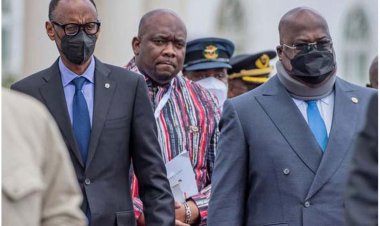
On December 4, 2025, Congolese President Felix Tshisekedi and Kagame signed in Washington a peace and economic agreement aimed to end fighting in Congo’s restive region.
The deal entails both countries to cease backing militias and non-state armed groups, including the neutralization of FDLR, based in eastern Congo.
“Rwanda is ready to lift its defensive measures in tandem with the DRC fulfilling its obligations under the Washington Accords,” Kagame said.
His remarks came days after the US announced sanctions against Rwanda Defense Forces and four of its senior officers over alleged support to the March 23 rebel group in eastern Congo.
Despite the Washington accords and the commitment in Doha to a permanent ceasefire and a permanent cessation of hostilities, fighting has flared recently between M23 and government forces.
Kagame said the conflict in eastern Congo is neither new nor too difficult to understand, but it has been prolonged for decades due to neglect and complacency notably by those with the power to make the biggest difference in resolving it.
He called for equal treatment as regards violations of the Trump brokered peace deal.
“By definition, a signed peace agreement should bind all parties equally and implementation should follow the text. However, this has not been our experience. What we see instead, is that one party is expected to carry almost the whole burden,” he said.
He said the Washington Accords clearly set a ceasefire, acknowledged each party’s security concerns and laid out the roadmap for action, and all parties should be held to the same standards.